Posts Tagged ‘Innocence Project of Florida’


MAYDAY: A Call of the Innocent

Ileejah Hutchinson — May 21, 2013 @ 3:20 PM — Comments (0)

Mayday, mayday, mayday!

This universal call is used to signal and aid individuals who are in distress and seeking assistance. The term is mainly used by marines and aviators; however, in some countries it is also used by law enforcement, fire departments and transportation groups.

The mayday call, which originated in the early 1920s, comes from the French words “venez m’iader,” which means “come and help me.” After a mayday call is given and if there is no response from the coast guard or any person designated to assist within two minutes, any person who hears the call for distress is required to perform a mayday relay, which is a call by one vessel on behalf of another.

IPF has vigorously worked for 10 years to aid persons in distress as a result of wrongful convictions. Exonerees such as, Orlando Boquete, William Dillon and Derrick Williams, to name a few, are perfect examples of successful mayday relays.

The United States of America prides itself on having the best criminal justice system in the world. Sadly it has been proven time and time again that the system is not immune to human error and in some cases, willful misconduct by prosecutors and law enforcement, and outright lies by jailhouse snitches. An innocent person, generally, believes that the justice system will do nothing but protect them, and do its best to eradicate the actual criminals.

Boquete, Dillon and Williams, collectively, spent 58 years in prison before their “mayday calls” were answered. Like all exonerees, Dillon made multiple cries for help; “to anyone who might listen” is how Dillon describes his desperate pleas. Finally with the help of IPF and assistant public defender Mike Pirolo, DNA testing on a key piece of evidence proved that Dillon was innocent. Dillon’s distress calls were finally answered after more than 27 years.

Williams’ sister-in-law took the first step in successfully performing a mayday relay on his behalf. With the help of IPF, Williams was finally able to go home after serving 18 years in prison.

Later this week Orlando will celebrate the 7th anniversary of his exoneration – the day his call for help was answered.

Place yourself in the shoes of Boquete, Dillon, or Williams – imagine spending years locked away from loved ones, family and friends; imagine not being able to fulfill the goals you mapped out for yourself; imagine not being able to make choices of what to eat and where to go. The small things we take for granted everyday are the things they missed, because the system failed and they were convicted of crimes they did not commit.

Because prosecutors, judges, and the State have turned their backs and ignore the cries of the innocent, IPF will continue to respond to mayday calls from those in Florida’s prisons.

It is everyone’s obligation to assist after hearing a mayday call, a cry from the wrongfully convicted, a cry that will prove to be the first step in unlocking the truth. Your assistance can be in many forms – share this post, tell others about IFP and our work, and provide financial support so we can bring home the innocent still in prison.

exoneration,Innocence Project of Florida,justice,prison, , , , , , ,


New DNA Testing Reveals Florida Death Row Inmate’s Innocence

Anna Fitzpatrick — May 16, 2013 @ 4:44 PM — Comments (2)

DNA helped send Clemente Javier “Shorty” Aguirre to death row in 2006 for the murder of two Altamonte Springs neighbors. Now a team of attorneys have used a new round of DNA testing to prove the innocence Aguirre has been maintaining from the start. This round of DNA testing implicates the victim’s daughter, Samantha Williams, as the real perpetrator.

Cheryl Williams and Carol Bareis, Aguirre’s next-door neighbors, were mother and daughter found stabbed to death in their trailer in Seminole County on June 17, 2004. An undocumented Honduran, Aguirre initially told police that he didn’t know anything about the murders, though later that same day he admitted that he had discovered their bodies around six a.m. when he went to their house hoping to get some beer. When he found Cheryl Williams’ body lying in the foyer, he rolled her over to check for a pulse. Once he realized she was dead, he feared the killer may still be present and grabbed the knife near Cheryl’s body before walking through the rest of the house. When he realized no one was there, he panicked, discarded the knife, went home and stuffed his now-bloody clothes into a trash bag and threw them on the roof. He didn’t report the crime because he feared deportation.

At trial, the State prosecution presented DNA evidence to show the the victims’ blood was on Aguirre’s clothes, shoes, and the bloody knife, which is consistent with Aguirre’s testimony of how he discovered the bodies. The defense, unfortunately, conducted no tests on other bloodstains nor did they even view any of the 197 items of evidence that were collected in this case, much less retain a forensic expert to examine them. The State also offered testimony from a “bloodstain pattern expert” who claimed the stains on Aguirre’s clothes were “impact” or “cast off” rather than “transfer” (which is consistent with Aguirre’s testimony) and alleged that the murders occurred around eight or nine a.m., arguing in closing that Aguirre may have still been in the home when Samantha Williams’ then-boyfriend came to get her work clothes and discovered the bodies. The defense failed to retain any blood pattern, pathologist, or other forensic experts to counter the State’s theories or support Aguirre’s account.

Furthermore, at no time during the trial did Aguirre’s lawyer inquire about or otherwise present the jury with any of the readily-available evidence that Samantha was mentally ill, unstable, and had a volatile and at times violent relationship with her mother, including at least one prior threat to kill her.

On at least three occasions since the murders, Samantha has become so violent and uncontrollable that she has been involuntarily committed to psychiatric facilities. Nearly three years prior to the murders, Samantha had been committed to psychiatric care by her mother, during which time she threatened to kill her mother in the presence of others. Then in December 2007, she was videoed as she repeatedly banged her head against the interior of a police car, sobbing, “my family died from me,” and then threatened to “murder” the officer who had taken her into custody. Again in August 2010, police were called to her home after she tried to set herself on fire and told a neighbor that “demons are in her head and caused her to kill her family.”

The attorney who represented Aguirre at his trial has been found constitutionally ineffective by the courts in at least one other death penalty case he handled. In total, Aguirre’s trial attorney has at least ten former clients presently on Florida’s death row.

In August 2011, Aguirre’s new counsel at the Capital Collateral Regional Counsel – Middle in Florida, in consultation with the Innocence Project, filed a motion for post-conviction DNA testing which found that most of the bloodstains were traced to one or both victims, while no blood from Aguirre was found at the scene. By contrast, two distinct bloodstains were found to come from Samantha and were located in close proximity to the victims’ blood. Although opposed by the State, a second round of testing revealed a total of eight different bloodstains have been identified as Samantha’s, which were spread out over four rooms of the home, each near blood from one or both victims.

At the hearing that began in Sanford, Florida on May 13, 2013, Aguirre’s lawyers will be asking for post-conviction relief based on three separate grounds:

  1. that Aguirre’s lawyer was ineffective for failing to conduct DNA testing and investigate Samantha’s mental health history,
  2.  the new DNA evidence and pre- and post-trial violence by Samantha constitute newly discovered evidence that would have led the jury to an acquittal, and
  3.  the new evidence establishes Aguirre’s innocence.

In what seems like such a clear-cut case of innocence, it is certainly disturbing to consider the lengths the State has gone to in order to protect Samantha Williams from conviction, despite her long history of violence, instability, and pure animosity, while turning a blind eye to the injustices suffered by Aguirre.  Should Aguirre be exonerated, the State will have fought against the freedom of an innocent person and possibly undercut their ability to prosecute the real perpetrator.  This would be the ultimate injustice to both Mr. Aguirre and the victims in this case.

Aguirre is represented by Maria DeLiberato and Marie-Louise Samuels Parmer with the Capital Collateral Regional Counsel – Middle Region.  Nina Morrison and Barry Scheck of the Innocence Project and Seth Miller and Melissa Montle of the Innocence of Florida are serving as co-counsel.

Constitution,Innocence Project of Florida,judicial,justice,post-conviction, , , , , , , , ,


Bloodsworth and Colbert – The Tough Questions

Jessica — March 06, 2013 @ 12:40 PM — Comments (0)

On March 4, 2013, The Colbert Report featured Kirk Bloodsworth, the first person exonerated from death row using DNA testing. Today Bloodsworth is the Advocacy Director for Witness to Innocence, an organization that is actively advocating the repeal of the death penalty in all states.

Through humor and jokes, Stephen Colbert asked the difficult questions about the death penalty, wrongful convictions and DNA exonerations, including “how do you plan on abolishing the death penalty?” and “what are the effects in the repeal of it?” His unique approach brought home the point that Bloodsworth actively advocates – if one innocent person dies due to the death penalty, then that is one too many.

To view the Bloodsworth interview, click below.

 
Kirk Bloodsworth was sentenced to death in Maryland in 1985 for the rape and murder of a nine year old girl, Dawn Hamilton. He served nine years in prison when, in 1993, post conviction DNA testing proved Bloodsworth was not Hamilton’s killer. His conviction was overturned and he was exonerated. Kirk Bloodsworth was the first inmate to be exonerated from death row. His case was much like many others and since then, 142 men and women have be released from death row.

exoneration,post-conviction, , , , , , ,


William Michael Dillon on Fox and Friends

Seth — July 31, 2012 @ 8:40 AM — Comments (1)

Florida exoneree made national headlines this month when he sang the National Anthem at a Tampa Bay Rays game.  This weekend he appeared on the Fox and Friends morning show.  You can check out his appearance here.


exoneration,Innocence Project of Florida, , , , ,


William Dillon’s national anthem rendition gets worldwide coverage

Jordan — July 19, 2012 @ 4:06 PM — Comments (0)

It was awesome to see William (Bill) Dillon sing the “Star-spangled Banner” (click for video) before the Tampa Bay Rays’ baseball game last night. IPF staff, interns, former interns, board members and their families turned out to support William in this amazing opportunity. For him personally, it represented and upheld many values and talents.

Bill was a few days shy of his second try-out with the Detroit Tigers when he was questioned and eventually arrested for a murder that DNA testing years later proved he did not commit. His other promising talents included working as carpenter and a mechanic in a bowling alley.

Bill is also an artist. He has been singing since he was a little boy. His songwriting and singing abilities garnered national attention with the release of his first album, Black Robes and Lawyers. Therefore, singing before a baseball game was the ultimate mesh of his talents.

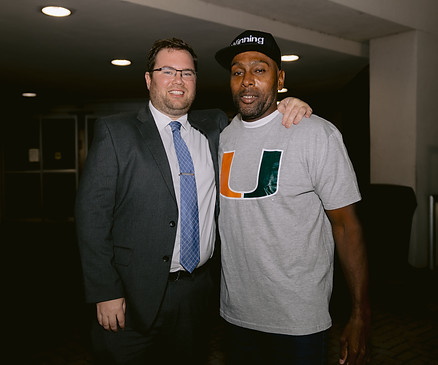
(L to R) Our most recent exoneree, Derrick Williams, with William Dillon and IPF board member Bob Cromwell, who was instrumental in connecting William Dillon with the Rays organization.

Fox News asked Bill how he felt prior to taking the field to sing and throw the first pitch: “It’s a miracle in its own right. I just hope it’s not so emotional for me that I can’t sing the song.”

Wearing the shirt he wore on the first day of freedom, Bill sang the nation’s song that celebrates its own freedom. By doing so, he demonstrated his own gratefulness for freedom with his renewed trust in the country.

ABC News quoted Bill saying, “I firmly believed in the justice system….I was so young and naive. It wasn’t until I was in prison that I realized I was stuck.”

But Bill now wishes to represent the possibilities of America: “I firmly believe in freedom and I believe America stands for freedom. I’m a symbol of hope that things can happen even if you lose hope you have to keep going on. All they have to do is look at my story. You can’t give up.”

IPF staff and interns attended to support

Additional coverage of Bill’s story can be found at the Huffington Post, Fox News, The American Bar Journal and the Daily Mail.

You can read more in-depth about his conviction and exoneration on his case profile page.

exoneration,Innocence Project of Florida,post-conviction, , , , , , ,


William Dillon to Perform at IPF’s First Annual Gala

Chelsea — March 28, 2012 @ 1:23 PM — Comments (2)

Can you imagine losing decades of your life to punishment for a crime you did not commit?

Florida’s 13 DNA exonerees don’t have to imagine; they know just how it feels to serve time for crimes that they had nothing to do with. At Steppin’ Out with the Innocence Project of Florida, IPF’s first annual gala, you will get to hear the stories of these amazing men. Amazing, inspiring, and horrifying – the stories that they have to offer are the best proof that our justice system is broken and needs to be fixed.

William “Bill” Dillon is one of Florida’s DNA exonerees, and he will share his stories through song with a performance at this special event. Dillon learned to play guitar while serving 27 years for a murder he didn’t commit and released his first album, Black Robes and Lawyers, in 2011.

Reserve your spot today to step out for justice and hear these inspiring men share their stories.

exoneration,Innocence Project of Florida,justice, , , , , , , , , ,


Dillon Got What He Needed & Deserved: An Apology and Compensation

Chelsea — March 15, 2012 @ 10:10 AM — Comments (1)

March 1, 2012 will be a day William Dillon will always remember. William served 27.5 years for a murder he did not commit. He was proven innocent using DNA testing in 2008. He waited 3.5 years for the State to do the right thing and they have.

Gov. Rick Scott apologized multiple times to William during the signing of the bill that will compensate William for his wrongful conviction and wrongful incarceration.

Read more coverage of the day: here, here, here, and here.

Innocence Project of Florida,legislation, , , , , ,


Larry Marshall to Speak At Innocence Project of Florida’s Gala

Chelsea — March 12, 2012 @ 1:55 PM — Comments (1)

The Innocence Project of Florida is thrilled to have Professor Larry Marshall as the guest speaker at our gala.

Professor Marshall currently serves as the Associate Dean for Clinical Education and David & Stephanie Mills Director of the Mills Legal Clinic at Stanford Law School. He is a nationally renowned advocate for reform of the U.S. criminal justice system and has been widely recognized for his lawyering, activism and teaching. Before joining Stanford’s faculty, Professor Marshall taught at Northwestern University School of Law and was a co-founder and legal director of the Center on Wrongful Convictions.

IPF is honored to have such a distinguished member of the innocence movement taking part in our celebration. Get your ticket to come see Professor Larry Marshall and hear our exonerees’ incredible stories today!

Innocence Project of Florida,justice, , , , , ,


Innocence Projects Address the Symptoms, Not Causes, of Wrongful Convictions

Chelsea — February 15, 2012 @ 5:58 PM — Comments (3)

Cook County State’s Attorney Anita Alvarez announced last week the formation of a review unit for questionable prosecutions. Chicago’s State’s Attorney office has received a lot of criticism for the way that they have handled a number of cases in recent years. According to the Chicago Tribune, “more than a dozen older Cook County prosecutions fell apart after men were wrongfully convicted amid allegations of police torture, coerced confessions or DNA evidence that implicated others in a crime,” since Alvarez was elected in 2008. Alvarez says that the founding of this unit marks a “shift in philosophy” for her office with regard to cases involving prosecutorial misconduct and wrongful convictions.

While no one can argue that measures like this are a positive step for our justice system, they do not come close to solving the problems. The advent of DNA testing and its use in the criminal justice system have changed the legal system tremendously. Beyond a reasonable doubt becomes exceedingly possible when there is DNA evidence to prove it. That said, the technology has changed the system, but the system has not made the necessary changes to take advantage of the technology. As the Innocence Project (NY) points out, “DNA exonerations do not solve the problem, they provide scientific proof of its existence and they illuminate the need for reform.”

Many states are taking steps towards these necessary reforms; the above unit in Chicago, Ohio studies on the death penalty, the Florida Innocence Commission, and DNA database expansion in New York. Inquiries into the system are the first step towards reforming the system but we cannot stop there. Keep an eye out for an upcoming post about the Monday meeting of the Florida Innocence Commission for information about how Florida’s Supreme Court task force is moving forward with reforms to help prevent wrongful convictions.

exoneration,justice,policy, , , , ,


Steppin’ Out With the Innocence Project of Florida Tickets Now Available

Chelsea — February 08, 2012 @ 1:40 PM — Comments (0)

Tickets for the Innocence Project of Florida’s First Annual Gala are now available! Join us for our inaugural celebration dinner honoring those who consistently step out to unlock the truth for the innocent in Florida’s prisons. The dinner program will highlight the inspiring stories of the 13 Florida DNA exonerees and honor those who have had a significant impact on improving justice in the state of Florida.

The gala will take place at the Four Season Hotel in Miami, FL on April 27, 2012. The evening will include a VIP reception with honorees, exonerees & speakers; silent auction with original artwork; dinner with a keynote speaker; and awards program.

This special event seeks to raise $100,000 to allow the Innocence Project of Florida to continue its mission to find and free innocent people from Florida prisons and help them rebuild their lives.

To purchase tickets for this special evening simply click here, or for more information check out the event’s page. We look forward to seeing you in April!

Innocence Project of Florida, , , ,

© Copyright Innocence Project of Florida, Inc. This web site is supported in part by grants from The Florida Bar Foundation.